
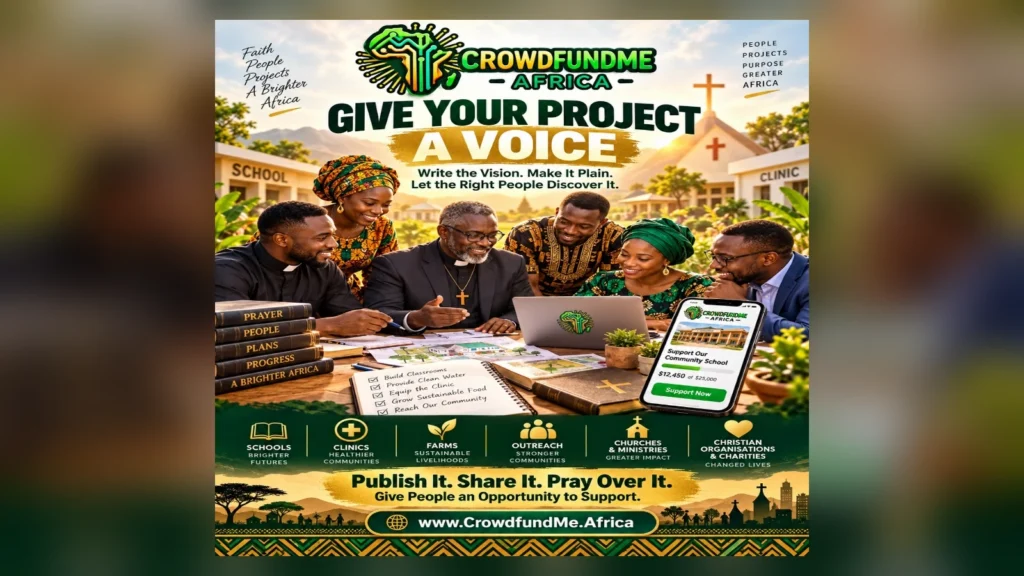
Many churches, ministries, Christian organisations and charitable groups carry powerful ideas that could transform lives.
Some dream of building schools, hospitals, farms or vocational training centres. Others want to support vulnerable families, fund missionary work, empower young people, provide scholarships, create community programmes or launch initiatives that can bring hope to entire communities.
Yet many of these visions never move beyond conversations, prayer meetings or small internal discussions.
The idea is there.
The need is real.
The desire to help exists.
But the wider world has never heard about it.
That is why giving your project a voice matters.
Publishing your vision on CrowdfundMe.Africa is not simply about asking for money. It is about making your project visible, explaining why it matters and giving willing people an opportunity to understand, support and share what you are trying to achieve.
Why Visibility Matters in Fundraising
A project that remains hidden can only reach a limited audience.
People cannot support what they do not know exists.
They cannot understand a need that has never been explained.
And they cannot respond to an opportunity they have never seen.
This is one of the most important principles of modern fundraising:
Visibility creates opportunity.
When you write your project clearly and publish it online, your message can move beyond your immediate congregation, family, organisation or community.
Someone in another city may discover it.
A supporter in another country may connect with it.
A professional may offer expertise.
A business may decide to contribute.
A donor may share it with a wider network.
A diaspora organisation may recognise that your project aligns with the causes it wants to support.
You cannot control who will see your campaign.
But you can make sure the campaign is available to be seen.
“Write the Vision and Make It Plain”
Habakkuk 2:2 says:
“Write the vision, and make it plain upon tables, that he may run that readeth it.”
For Christian organisations, this Scripture provides a powerful reminder about the importance of communicating a vision clearly.
An idea that exists only in your mind may remain unknown to everyone else.
But once it is written, organised and explained, people can begin to understand it.
In practical fundraising terms, this means answering important questions such as:
- What is the project?
- Why is it needed?
- Who will benefit?
- How much money is required?
- How will the funds be used?
- What stage is the project currently at?
- What difference will support make?
- How can people participate?
A clear campaign gives supporters something they can read, understand and consider.
Your Project Needs More Than Prayer — It Also Needs Communication
Prayer is central to the life of many Christian organisations.
Churches may pray for provision.
Ministries may pray for partners.
Mission groups may pray for doors to open.
Charities may pray for the resources required to continue their work.
But faith and practical action do not have to compete with each other.
You can pray and communicate.
You can trust God and prepare a fundraising plan.
You can seek spiritual direction and still explain your project clearly to people.
Publishing a project does not mean you are attempting to force an outcome.
It means you are creating an opportunity for people to discover the need.
Prayer may prepare the heart. Communication allows the message to be heard.
Consider a Church Building a School
Imagine a church that wants to establish a school in a community where children have limited access to quality education.
The congregation may already understand the vision.
Members may be praying.
A committee may have been formed.
Land may have been identified.
But if the project is never communicated outside the church, thousands of potential supporters may never hear about it.
Now imagine the church creates a clear crowdfunding campaign explaining:
- The educational problem
- The number of children who may benefit
- The location
- The construction plan
- The funding target
- The budget
- The timeline
- The long-term vision
The campaign is then shared through CrowdfundMe.Africa, WhatsApp, Facebook, email, alumni groups and diaspora networks.
The project now has a voice.
Someone may donate.
Someone may provide building materials.
An architect may offer professional assistance.
A teacher may volunteer.
A business may sponsor equipment.
A diaspora association may decide to adopt part of the project.
The fundraiser cannot guarantee any of these outcomes.
But communicating the vision creates possibilities that silence does not.
Crowdfunding Is Not Begging
This is particularly important for churches, ministries and community leaders who may feel uncomfortable asking for financial support.
There is a difference between begging and responsibly presenting a genuine opportunity for voluntary support.
Crowdfunding allows you to explain:
what you want to accomplish, why it matters, what resources are required and how others can participate.
People remain free to decide whether they want to contribute.
One person may give £5.
Another may give £100.
Another may share the campaign.
Someone may contribute equipment rather than money.
Another supporter may introduce you to an organisation.
The purpose is not to pressure people.
It is to invite participation.
“How Shall They Hear?”
Romans 10:14 includes the question:
“And how shall they hear without a preacher?”
In its biblical context, the passage concerns the proclamation of the Gospel.
But there is also a broader communication principle we can recognise:
A message must be communicated before people can respond to it.
A healthcare project must explain the medical need.
An education project must explain why students need support.
A farming project must explain how the initiative will work.
A missionary programme must explain its purpose.
A food programme must explain who it serves.
A vocational centre must explain what skills it intends to provide.
Do not assume people somehow know what your ministry or organisation needs.
Tell them.
Write it down.
Make it understandable.
Publish it.
Share it responsibly.
A Strong Fundraising Campaign Gives Your Vision Structure
A crowdfunding campaign should do more than say:
“Please help our ministry.”
That is too broad.
A stronger campaign might say:
“We are raising £15,000 to equip a vocational training centre that will provide tailoring, digital skills and electrical training to 100 young people in our community.”
The stronger version immediately tells the reader:
what the project is, how much is required and who will benefit.
That clarity is important.
Explain Where the Money Will Go
Transparency is essential.
If you are asking people to support a project, explain how the funding will be used.
For example:
Equipment — £6,000
Training materials — £3,000
Facility improvements — £2,500
Technology and internet — £2,000
Project administration — £1,500
This does not mean every campaign must use exactly this structure.
The important principle is that donors should understand the purpose of the funding.
Transparency builds confidence.
Your Vision May Be Exactly What Someone Wants to Support
There are donors who care deeply about:
- Christian missions
- Education
- Healthcare
- Youth empowerment
- Agriculture
- Poverty reduction
- Women's empowerment
- Skills training
- Community development
- Disability support
- Orphan care
- Clean water
- Food security
Your project may already align with someone's interests.
But they cannot support it if they never discover it.
That is why visibility matters.
Ecclesiastes and the Principle of Taking Action
Ecclesiastes 11:1 says:
“Cast thy bread upon the waters: for thou shalt find it after many days.”
This verse has been interpreted in different ways, but one practical lesson that can be drawn from it is the importance of taking action without always knowing the eventual result.
Fundraising is similar.
You cannot predict exactly who will see your campaign.
You cannot guarantee who will donate.
You cannot know which person will share it with the right organisation.
But you can make the project visible.
You can tell the story.
You can create the opportunity.
Churches Should Think Beyond the Sunday Offering
Church offerings remain important to many congregations.
But large community projects may require support beyond one congregation.
A church may want to fund:
- A school
- A health centre
- A community farm
- A missionary project
- A youth centre
- A rehabilitation programme
- A food bank
- A scholarship fund
- A housing project
- A vocational centre
Crowdfunding can help extend the reach beyond the people sitting in the building on Sunday.
Members can share the campaign with relatives.
Former members can contribute from abroad.
Diaspora Christians can participate.
Partner churches can help.
Supporters who believe in the cause can join even if they have never visited the congregation.
This is one of the greatest advantages of digital fundraising.
Christian Organisations Should Build Trust
Faith does not remove the need for accountability.
In fact, organisations asking people to give should take transparency very seriously.
A good campaign should be clear about:
- Who is organising the fundraiser
- Who owns or manages the project
- The target
- The budget
- The expected outcome
- How contributions will be handled
- How supporters will be updated
Regular updates can include:
- Photographs
- Construction progress
- Beneficiary stories
- Financial milestones
- Project completion reports
People appreciate seeing what their support helped accomplish.
Do Not Overpromise
Avoid making guarantees such as:
“God will make sure everyone who donates receives financial blessings.”
Giving should never be presented as a financial transaction with God.
Instead, invite people to support voluntarily and prayerfully.
The fundraiser's responsibility is to communicate honestly and manage resources faithfully.
The donor's decision should remain free.
Make Your Campaign Easy to Share
A strong campaign should be easy for supporters to pass on.
Prepare a short WhatsApp message.
Prepare a Facebook post.
Prepare an email version.
Create a clear poster.
Record a short video explaining the project.
Give supporters the campaign link and ask them to share it.
The easier you make it for people to spread the message, the further your vision can travel.
Think About the Diaspora
Churches and ministries across Africa often have former members, relatives and supporters living abroad.
These diaspora networks can be extremely valuable.
A church in Nigeria, Ghana, Kenya, Zambia, Zimbabwe, Uganda, Sierra Leone or another country may have supporters living in:
the United Kingdom, United States, Canada, France, Germany or elsewhere.
Crowdfunding provides a practical way to connect these networks around one clear project.
Do not simply say:
“Send us money.”
Explain the project.
Show the need.
Provide updates.
Build trust.
Invite partnership.
Give People More Than One Way to Participate
Not everyone will be able to donate.
That does not mean they cannot help.
Invite people to:
- Donate
- Share
- Volunteer
- Offer expertise
- Introduce potential partners
- Provide equipment
- Sponsor part of the project
- Pray
- Help promote the campaign
The strongest projects often develop communities around them.
A Simple Formula for a Faith-Based Crowdfunding Campaign
Your campaign can follow this structure:
1. The Vision
What has your church or organisation been called to do?
2. The Need
What problem are you trying to address?
3. The Beneficiaries
Who will benefit?
4. The Plan
How will the project work?
5. The Budget
How much do you need and why?
6. The Impact
What will change if the project succeeds?
7. The Invitation
How can someone contribute?
8. The Accountability
How will supporters receive updates?
That structure turns a general idea into a campaign people can understand.
Give Your Project a Voice
Perhaps your church has been discussing a project for years.
Perhaps your organisation has a vision but lacks the resources to move forward.
Perhaps your ministry has been praying for partners.
Perhaps your charitable programme needs more support to reach vulnerable people.
The project may not need another private conversation.
It may need a voice.
Write it clearly.
Explain it honestly.
Make the need visible.
Publish it.
Share it.
Pray over it.
And give people the freedom to decide how they wish to participate.
At CrowdfundMe.Africa, crowdfunding can become a bridge between vision and visibility — helping churches, ministries, Christian organisations and charitable groups communicate worthwhile projects to wider communities.
Your responsibility is to communicate the vision.
Your responsibility is to maintain transparency.
Your responsibility is to use support faithfully.
And your responsibility is to keep supporters informed.
You cannot guarantee who will respond.
But you can ensure that your vision is no longer hidden.
Write the vision. Make it plain. Give it a voice.
CrowdfundMe.Africa — Your vision deserves to be heard.
Make it visible. Tell the story. Invite people to participate.
Visit: www.CrowdfundMe.Africa