How a Strong Culture of Giving Can Change Lives
Across Britain and many parts of Europe, charitable giving has become an important part of everyday community life.
People regularly donate to charities, sponsor friends taking part in fundraising events, support emergency appeals, contribute to medical causes, give to schools and community projects, help homeless people, support food banks, fund research, donate to disaster relief campaigns and contribute through online crowdfunding platforms.
This does not mean that every person in Britain or Europe is wealthy.
It does not mean that poverty or hardship does not exist there.
And it certainly does not mean that Africans are less generous.
Africans have a very strong tradition of helping family members, neighbours, churches, mosques, village associations and community groups.
The important lesson is different:
Britain and many European societies have developed systems that make everyday giving easier, more visible and more organised.
Crowdfunding is one of those systems.
For Africans both at home and in the diaspora, there is much we can learn from the way ordinary people use small contributions to support causes they care about.
Giving Is Part of Everyday Life
In Britain, fundraising is often visible everywhere.
A person may be asked to sponsor a colleague running a marathon.
A parent may donate to a school fundraising appeal.
A supermarket customer may contribute to a food bank.
A church member may support an emergency appeal.
An employee may raise money for a cancer charity.
A family may create an online fundraising page for somebody facing a medical emergency.
A community may raise money to support a local project.
A charity may launch an online campaign to help vulnerable people.
These acts of giving become normal because people see them regularly.
The amount given may be small.
£2.
£5.
£10.
£20.
But when many people participate, the impact becomes much larger.
That is one of the greatest lessons crowdfunding teaches us.
You do not need one millionaire when you have thousands of ordinary people willing to contribute.
Crowdfunding Has Made Giving Easier
Before online crowdfunding, fundraising was often more difficult.
People relied on cash collections, meetings, church announcements, community events or personal appeals.
Today, a person can create a fundraising campaign and share it through:
- TikTok
- Community groups
- Workplace networks
- Family networks
A potential donor can read the campaign story and make a contribution within minutes.
Technology has reduced the distance between the person who needs help and the person who wants to give.
That is a major opportunity for Africa.
Britain Shows the Power of Small Contributions
One of the important habits we can observe in Britain is that people do not always wait until they can make a large contribution.
If £5 is what they can afford, they may give £5.
If £10 is appropriate, they may contribute £10.
People often understand that their donation is only one part of a much larger fundraising effort.
This is exactly how crowdfunding succeeds.
For example:
100 people giving £5 = £500
1,000 people giving £5 = £5,000
10,000 people giving £5 = £50,000
The individual donation may appear small.
The collective result is not small at all.
Africans should increasingly embrace this principle.
We should stop thinking:
“My contribution is too small to matter.”
Instead, we should think:
“I will contribute what I can, and others can do the same.”
Charitable Giving Helps Communities Solve Real Problems
The most important thing about charitable giving is not simply moving money from one person to another.
It is what that money can achieve.
Across Britain and Europe, charitable donations help support many areas of society.
They can contribute towards:
- Cancer research
- Hospices
- Mental health services
- Disability support
- Children's charities
- Homeless shelters
- Domestic abuse services
- Food banks
- Refugee support
- Community centres
- Education projects
- Medical research
- Elderly care
- Emergency relief
- Animal welfare
- Environmental projects
The lesson for Africa is that crowdfunding and charitable giving can also help tackle real problems within our own communities.
Imagine What Stronger Crowdfunding Could Do Across Africa
Consider the challenges facing many African communities.
Students unable to continue education.
Families facing medical emergencies.
Small businesses without enough startup capital.
Women seeking economic independence.
Young people needing skills training.
Rural communities lacking clean water.
Schools needing equipment.
Charities struggling to fund programmes.
Farmers needing tools.
Families affected by disasters.
Children requiring specialist treatment.
These are precisely the types of situations where crowdfunding can become useful.
Crowdfunding will not replace government.
It will not replace social welfare.
It will not solve every problem.
But it can become another powerful tool available to communities.
Africans Are Already Generous
We must also recognise something important.
Africans are not strangers to generosity.
Many Africans regularly send money to relatives.
People contribute towards funerals.
Families help pay school fees.
Communities support weddings.
Church members contribute offerings.
Muslims give zakat and other charitable support.
Diaspora Africans send billions back to relatives and communities.
Village associations finance local projects.
Friends contribute when somebody becomes ill.
The generosity already exists.
What Africa needs is to connect this culture of giving more effectively with digital fundraising technology.
Instead of generosity remaining mainly within close family networks, crowdfunding can allow it to reach wider communities.
The Diaspora Has an Important Role
Africans living in Britain, Europe, North America and elsewhere have a unique opportunity.
Many understand both African community culture and Western charitable fundraising systems.
They see how crowdfunding works.
They understand online payments.
They participate in charity events.
They may already donate to British or European charities.
There is nothing wrong with supporting charities in the country where you live.
But Africans in the diaspora can also consider supporting credible causes across Africa.
A person living in London may give £5 or £10 to an education campaign in Ghana.
Someone living in Germany may help a medical campaign in Nigeria.
An African living in France may support a community project in Senegal.
A Kenyan living in the United Kingdom may support a small charity back home.
A South African living abroad may help fund a youth initiative.
The diaspora can become an important bridge.
We Should Expand Our Definition of Who Deserves Our Help
Many Africans are extremely generous within their immediate circles.
We help:
our children, brothers, sisters, cousins, church members, friends and people from our hometowns.
This is valuable.
But perhaps we should also ask:
What about the person we do not personally know?
A child needing surgery may not be related to us.
A widow raising children may not attend our church.
A student needing tuition may come from another ethnic group.
A struggling family may live in another country.
An NGO feeding vulnerable children may be run by complete strangers.
If the cause is genuine and responsibly presented, why should compassion stop because we do not know the beneficiary personally?
This is another important lesson we can learn from modern charitable giving.
People often support causes because they believe in the need — not because they personally know the recipient.
Giving Should Not Be Limited to Religious Institutions
Faith communities play a very important role in Africa.
People regularly give:
- Tithes
- Offerings
- Zakat
- Church building contributions
- Thanksgiving donations
- Religious fundraising support
These forms of giving are meaningful.
But we can also broaden our generosity.
A person can support their church and still contribute to a medical fundraiser.
A Muslim can fulfil religious charitable obligations while also supporting a community education project.
A Christian can give offerings while helping an unrelated family facing hardship.
Generosity does not have to be confined to one institution.
Compassion can extend across society.
Crowdfunding Teaches Shared Responsibility
One of the strongest lessons from European charitable culture is the idea that improving society is not only somebody else's responsibility.
People often participate personally.
They volunteer.
They donate.
They sponsor.
They organise.
They share fundraising links.
They raise awareness.
The mentality becomes:
“What can I contribute?”
rather than only:
“Who should solve this problem?”
Africa can benefit greatly from this mindset.
Governments have responsibilities.
Businesses have responsibilities.
Charities have responsibilities.
But citizens also have power.
When communities participate, much more becomes possible.
Small Donations Can Give People Dignity
Crowdfunding can also help people receive assistance without depending entirely on one wealthy benefactor.
Imagine someone needs £5,000 for an urgent need.
They may feel uncomfortable approaching one individual and asking for the entire amount.
But if 1,000 people contribute £5 each, no single donor carries the full burden.
This spreads responsibility.
It also creates a community around the person or project.
That can be more empowering and dignified.
Giving Can Create Hope
When somebody is struggling, money is only part of the problem.
Sometimes people feel alone.
They may believe nobody cares.
When supporters begin donating and sharing their campaign, something important happens.
They realise:
“People believe my situation matters.”
That emotional support can be extremely powerful.
Crowdfunding can therefore create both financial support and hope.
Transparency Is Essential
For crowdfunding to grow successfully across Africa, trust must come first.
People will not continue donating if they believe fundraising platforms are full of fraudulent or misleading campaigns.
Fundraisers must therefore act responsibly.
They should clearly explain:
- Who they are
- Who will receive the funds
- Why the money is required
- How much is needed
- How funds will be used
- What progress has been made
They should also provide updates where appropriate.
Platforms also have a responsibility to introduce safeguards and verification systems.
Trust is the foundation of sustainable crowdfunding.
Fundraisers Must Respect Donors
Fundraisers should also understand that donors are not cash machines.
People have their own responsibilities.
They have bills.
Families.
Rent.
Food costs.
Medical expenses.
School fees.
Nobody should be pressured or embarrassed into giving.
Instead, invite support respectfully.
A good message might say:
“If you are able to contribute, we would sincerely appreciate your help. If you cannot donate, please consider sharing our campaign with others.”
That approach respects the donor.
Sharing Is Also a Form of Support
Another important lesson from online fundraising is that not everybody needs to donate.
Sometimes somebody cannot afford to give.
But that person may have a large network.
They can share the campaign.
Imagine one person shares a fundraiser with 50 people.
Ten people contribute.
That original person helped the campaign even without making a financial donation.
This is why every crowdfunding campaign should encourage both:
Donate if you can.
Share if you cannot.
Giving Should Become a Habit, Not Only a Reaction to Tragedy
Many people only donate when something terrible happens.
A death.
A disaster.
A medical emergency.
But charitable giving can also support prevention and development.
We can donate towards:
education before a child drops out.
Skills training before a young person becomes unemployed.
Healthcare before conditions become worse.
Community projects before infrastructure collapses.
Entrepreneurs before promising businesses disappear.
Preventative giving can be just as important as emergency giving.
Businesses Can Participate Too
Another lesson Africa can take from Western charitable culture is corporate participation.
Companies frequently support charities and community initiatives.
African companies can do more of this as well.
Small businesses, banks, telecommunications companies, supermarkets, technology firms and large corporations can support verified crowdfunding campaigns.
They can match employee donations.
They can sponsor causes.
They can provide grants.
They can encourage staff volunteering.
Crowdfunding platforms can help connect businesses with credible community initiatives.
Young Africans Can Lead a New Giving Culture
Africa has one of the world's youngest populations.
Young Africans are already comfortable with:
mobile phones, digital payments, social media, online shopping and mobile banking.
Crowdfunding fits naturally into this digital environment.
Young people can build a new culture where giving £1, £2, ₦500, KSh200 or another manageable amount becomes normal.
Imagine millions of young Africans supporting credible causes online.
The social impact could be enormous.
Africa Does Not Need to Copy Europe — We Can Build Our Own Model
The goal is not to say that Europe is better than Africa.
Nor should Africa simply copy everything done elsewhere.
Instead, we can learn what works and adapt it to African realities.
Africa already has community spirit.
Europe has developed strong digital fundraising habits and organised charity structures.
Combining African communal values with modern crowdfunding technology could create something very powerful.
CrowdfundMe.Africa and the Future of African Giving
At CrowdfundMe.Africa, our vision is to help make crowdfunding more accessible and understandable to Africans at home and abroad.
We want people to understand that fundraising does not have to depend on one wealthy donor.
It can depend on communities.
It can depend on small contributions.
It can depend on ordinary people deciding:
“I may not be able to solve everything, but I can help.”
That is the spirit we want to encourage.
The Lesson Is Simple
Britain and many parts of Europe show us what can happen when charitable giving becomes normal, organised and easy to access.
Africa already possesses something equally powerful:
a deep culture of community support.
Now we need to bring that generosity more strongly into the digital age.
Give to your family.
Support your church or mosque.
Help your community.
But when possible, also consider the stranger whose genuine need touches your heart.
The student.
The patient.
The widow.
The entrepreneur.
The charity.
The child.
The village.
The family you may never meet.
Because compassion does not require a family connection.
It only requires recognising another person's humanity.
We Can Learn to Give Beyond Ourselves
Africans both at home and in the diaspora have an opportunity to build a stronger culture of digital generosity.
A £5 donation may feel small.
A €5 contribution may feel small.
₦1,000 may feel small.
R50 may feel small.
KSh500 may feel small.
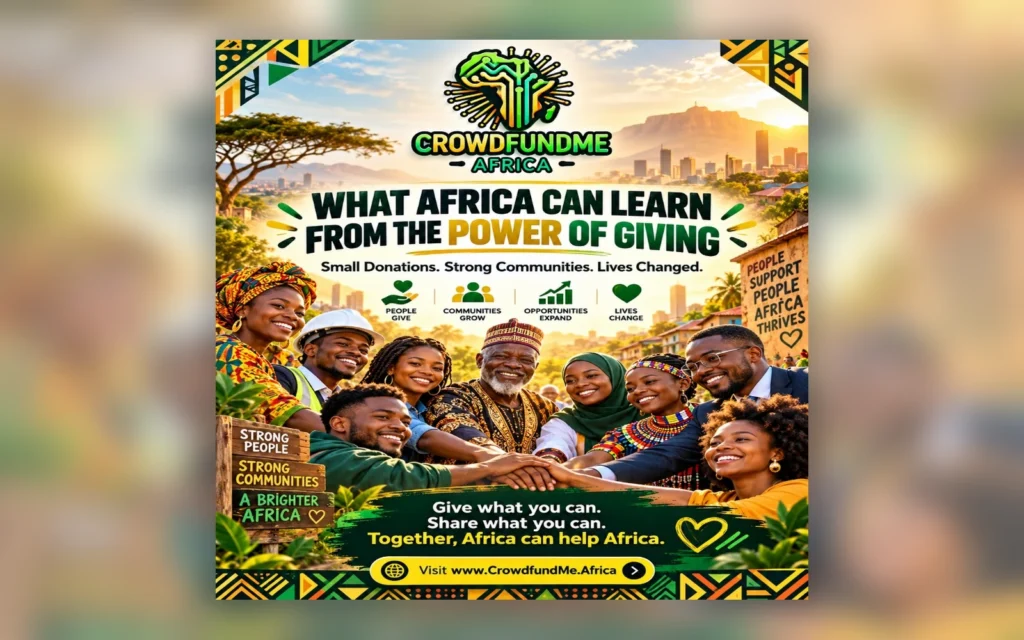
But multiplied across thousands of people, these contributions can fund education, treatment, community projects, charities and opportunities.
That is the power of crowdfunding.
That is the power of collective generosity.
And that is how ordinary people can help change extraordinary numbers of lives.
CrowdfundMe.Africa
Helping Africa Fund Africa — with support from the world.