Giving is not a modern invention. Long before digital payments, crowdfunding websites and online donation campaigns, communities survived and progressed because people supported one another.
Across Africa, the Caribbean and global diaspora communities, collective giving has always been deeply connected to family, identity, faith, survival and community development.
People contributed to weddings, funerals, school fees, medical treatment, new businesses, religious institutions and community projects. Resources were pooled because individuals understood a simple truth:
When one person struggles, the wider community is affected.
Today, migration and globalisation have spread families and communities across continents. But the instinct to help has remained.
What has changed is the method.
Digital crowdfunding now offers a modern way to continue an ancient tradition.
Platforms such as CrowdfundMe.Africa can help connect people at home and abroad, allowing communities to support causes in a more organised, visible and accessible way.
Giving Has Always Been Part of Community Life
In many African and Caribbean societies, generosity has traditionally gone far beyond individual charity.
It has often been a shared responsibility.
Communities have historically gathered resources to help people:
- Pay school fees
- Start businesses
- Meet medical expenses
- Build homes
- Support bereaved families
- Finance weddings
- Develop community facilities
- Assist people during emergencies
- Support churches, mosques and other institutions
These systems existed long before the word crowdfunding became popular.
In many respects, modern crowdfunding is simply a digital version of something communities have been doing for generations.
Ubuntu: “I Am Because We Are”
One of the strongest philosophical ideas associated with African communal life is Ubuntu.
It is often expressed through the idea:
“I am because we are.”
The principle reminds us that individual well-being is connected to the well-being of others.
A person's success does not exist entirely in isolation.
Families support children.
Communities support families.
Successful individuals often help relatives, neighbours and people from their hometowns.
This interconnectedness creates social resilience.
Crowdfunding can take that principle and expand it beyond geographical boundaries.
A person living in London can support a campaign in Lagos.
Someone in Toronto can contribute to a project in Accra.
A Kenyan living in Europe can help a family or community initiative back home.
A Caribbean professional in New York can support a project on an island thousands of miles away.
Technology allows the spirit of Ubuntu to travel.
Harambee: The Power of Pulling Together
Kenya provides another powerful example through the concept of Harambee, commonly associated with “pulling together.”
The principle is simple.
When a community needs something, individuals contribute whatever they can.
Some contribute money.
Others provide labour.
Some contribute materials.
Others use their networks.
The final achievement belongs to everybody.
This principle closely resembles modern crowdfunding.
One donor may give £5.
Another may contribute £50.
Another person may simply share the campaign with 100 contacts.
All three have contributed something useful.
Crowdfunding succeeds because people participate according to their ability.
Susu, Partner Hands and Caribbean Community Finance
Across the Caribbean and parts of West Africa, communities have also developed traditional rotating savings systems.
They may be known by different names, including susu, partner, partner hand, or other local variations.
Participants contribute regularly into a shared pool.
At agreed intervals, one member receives the pooled amount.
These systems demonstrate something very important:
Communities have always known how to organise money collectively.
The digital age is not creating this principle from nothing.
It is giving it new tools.
Migration Did Not End the Culture of Giving
When Africans and Caribbean people migrated to Britain, Europe, North America and other parts of the world, they did not abandon their responsibilities to family and community.
Instead, generosity became international.
People began sending money home for:
education, housing, healthcare, food, family emergencies, business investment and community projects.
This is commonly discussed as remittances, but remittances are only part of the story.
There is also diaspora philanthropy.
Diaspora communities often support:
- Schools
- Churches and mosques
- Hospitals
- Orphanages
- NGOs
- Community associations
- Disaster appeals
- Scholarships
- Medical treatment
- Village development
- Small enterprises
The emotional and cultural connection to home remains powerful even after decades abroad.
The Challenge: Giving Across Borders Has Not Always Been Easy
The willingness to help is strong.
The infrastructure has often been less effective.
Traditional cross-border giving can face several challenges.
1. High Transaction Costs
Money-transfer fees and currency conversion charges can reduce the amount that actually reaches the intended beneficiary.
For somebody making a small donation, this can be particularly significant.
2. Trust Concerns
Donors may wonder:
- Is the campaign genuine?
- Who is organising it?
- Will the money reach the beneficiary?
- Will the funds be used for the stated purpose?
- Will donors receive updates?
Without transparency, even generous people may hesitate.
3. Fragmented Fundraising
A fundraiser might be collecting:
cash from one person, bank transfers from another, mobile-money payments from others and contributions through several WhatsApp groups.
Keeping track can become difficult.
4. Platforms Designed for Other Markets
Some global crowdfunding services are primarily designed around Western banking systems and user behaviour.
African fundraisers may face difficulties involving:
local payment methods, currencies, payout arrangements, verification and regional fundraising practices.
This creates an opportunity for platforms designed with African users and diaspora supporters in mind.
From Informal Giving to Digital Crowdfunding
Digital crowdfunding can bring structure to traditional generosity.
Instead of individually contacting hundreds of people and attempting to manage contributions manually, a fundraiser can create one campaign page containing:
- The campaign story
- Photographs
- Fundraising target
- Beneficiary information
- Progress updates
- Donation options
- A shareable campaign link
That link can then be distributed through:
WhatsApp, Facebook, Instagram, TikTok, LinkedIn, email and community networks.
The ancient principle remains the same.
People help people.
Only the technology has changed.
Why Trust Matters More Than Ever
For digital crowdfunding to grow across Africa and the diaspora, trust must remain central.
A donor may never personally meet the beneficiary.
That means the fundraising platform and fundraiser must work harder to demonstrate credibility.
Good crowdfunding practices should include:
- Identity checks where appropriate
- Campaign review
- Clear beneficiary information
- Transparent fundraising goals
- Accurate descriptions
- Responsible use of photographs
- Updates about campaign progress
- Clear information about payouts and fees
Trust turns one-time donors into long-term supporters.
Without trust, digital generosity cannot reach its full potential.
CrowdfundMe.Africa and the Digital Evolution of Community Giving
CrowdfundMe.Africa can be understood as part of this wider evolution.
The goal is not to replace African or Caribbean traditions of giving.
It is to help bring those traditions into a digital environment.
A fundraising platform can provide a central place where individuals and organisations explain their causes and invite support from people both locally and internationally.
Potential causes may include:
- Medical emergencies
- Education
- Community development
- Charities and NGOs
- Disaster relief
- Family emergencies
- Religious and community initiatives
- Entrepreneurship
- Small business development
- Youth programmes
- Social-impact projects
The important principle is that people should be able to understand who needs help, why help is required and how their contribution may make a difference.
Helping Fundraisers Tell Their Stories Better
One of the difficulties many genuine fundraisers face is not the absence of a worthy cause.
It is the difficulty of explaining that cause.
A person may genuinely need support but struggle to write a persuasive campaign description.
That is why fundraising guidance can be valuable.
Tools such as campaign-writing assistance, fundraising guidance and educational blog content can help organisers understand how to:
- Explain their situation clearly
- Establish a realistic target
- Describe how the money will be used
- Approach donors respectfully
- Share campaigns effectively
- Provide updates
- Thank supporters
Technology should not simply collect money.
It should help people become better fundraisers.
The Diaspora Can Become a Powerful Force for Social Impact
Diaspora communities possess a unique advantage.
They often have:
financial resources, international networks, professional experience, technology access and emotional connections to their countries of heritage.
Imagine what could happen if diaspora giving became more coordinated.
Instead of one person repeatedly supporting only immediate relatives, diaspora communities could also collectively support verified:
schools, health programmes, scholarships, startups, community centres, charities and social enterprises.
This does not mean abandoning family responsibilities.
It means widening the circle of generosity.
From Remittances to Community Investment
Africa and the Caribbean already receive substantial financial support from their diasporas.
The next stage could involve encouraging some of that generosity towards organised community initiatives.
Imagine a diaspora association supporting:
a rural maternity clinic.
A university alumni group funding scholarships.
A professional association financing training for young graduates.
A church group supporting a verified community health campaign.
A group of former residents raising money for clean water.
Crowdfunding can help make these initiatives visible and measurable.
Small Contributions Can Become Powerful
Digital giving also changes our understanding of what constitutes a meaningful donation.
A person may think:
“I can only afford £5. It won't make any difference.”
But crowdfunding works through multiplication.
If 2,000 people contribute £5 each, that becomes £10,000.
If 10,000 people contribute £5 each, that becomes £50,000.
The individual contribution may be small.
The collective impact can be significant.
This principle is perfectly aligned with traditional communal giving.
Giving Is Also About Dignity
One of the most important principles in charitable giving is respecting the person receiving support.
Fundraising should never exploit suffering.
Beneficiaries should not be humiliated simply because they need help.
Stories should be truthful but respectful.
Photographs should be used responsibly.
Private information should be protected.
The purpose of crowdfunding should be to empower people — not reduce them to their hardship.
Giving Is More Than Money
Another important lesson from ancestral traditions is that contribution does not always mean cash.
People can contribute through:
- Sharing a campaign
- Volunteering
- Introducing potential supporters
- Offering professional expertise
- Providing equipment
- Giving mentorship
- Connecting organisations
- Raising awareness
Somebody unable to donate financially may still become one of the campaign's most important supporters.
Building a New Culture of Digital Philanthropy
Africa and the Caribbean have strong traditions of communal responsibility.
The challenge now is to combine these traditions with:
digital payments, transparency, verification, storytelling and global connectivity.
If this is done responsibly, crowdfunding can help create a stronger culture of digital philanthropy.
Not one based only on emergencies.
But one capable of supporting long-term progress.
Education.
Healthcare.
Entrepreneurship.
Innovation.
Community development.
Charities.
Social impact.
The Act of Giving Has Not Changed — The Tools Have
From Ubuntu and Harambee to susu groups, partner hands, family contributions and diaspora remittances, collective giving has always existed.
Modern crowdfunding is another chapter in that history.
Our ancestors gathered physically.
Today, communities can gather digitally.
Our ancestors contributed coins, crops, labour and resources.
Today, people can contribute through smartphones.
The technology is different.
The human instinct remains the same.
To help.
To support.
To build.
To protect.
And to ensure that when one member of the community faces difficulty, they do not necessarily face it alone.
Connecting Heritage With the Future
The future of African and diaspora philanthropy does not require abandoning tradition.
It requires building on it.
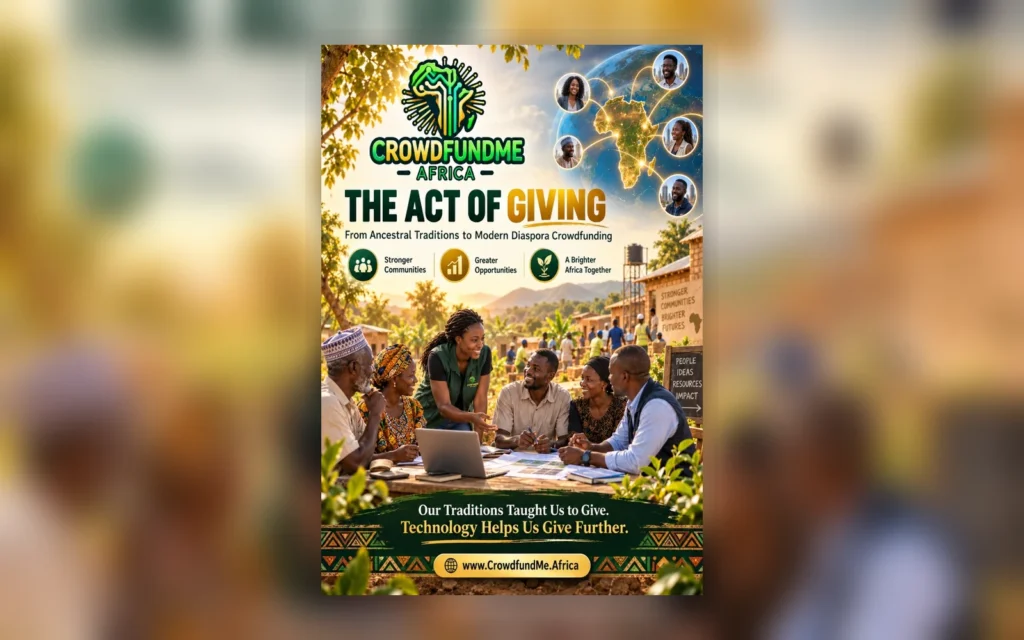
Our traditions teach us why we should help one another.
Technology gives us new ways to do it.
Crowdfunding can become the bridge between those two worlds.
A bridge connecting:
heritage and technology.
Africa and the diaspora.
people with resources and people with genuine needs.
individual generosity and collective impact.
That is the opportunity.
And that is why the act of giving remains as relevant today as it has been for generations.
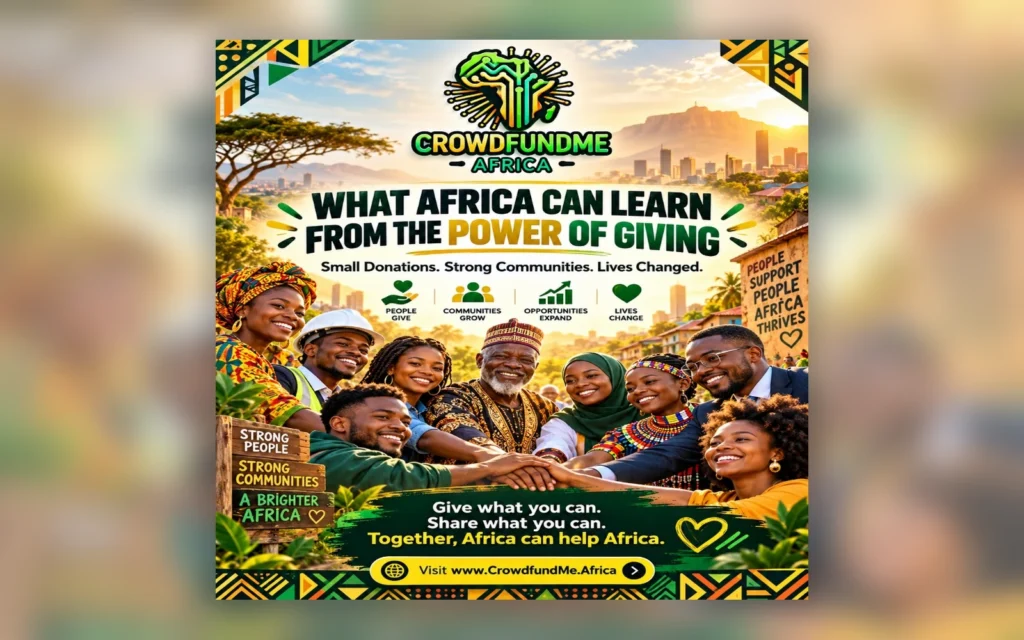
Give what you can. Share what you can. Help where you can.
Because when communities come together, generosity can travel across borders — and change lives.
CrowdfundMe.Africa
Helping Africa Fund Africa — with support from the global community.
Visit: www.CrowdfundMe.Africa