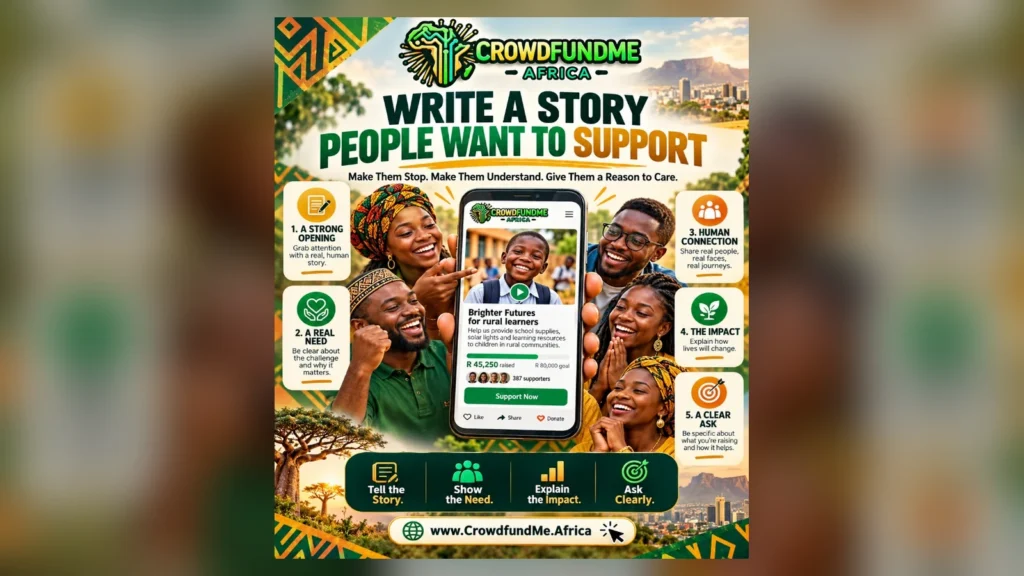
A fundraising campaign can have an important cause, a realistic target and genuine need — but if the story is weak, people may simply scroll past it.
That is because donors do not respond only to numbers.
They respond to people, emotion, clarity, trust and purpose.
A strong fundraising story helps a potential donor understand three things quickly:
What is happening? Why does it matter? How can I help?
For fundraisers using CrowdfundMe.Africa, learning how to tell your story properly can make a major difference.
1. Start With a Strong Opening
The first few lines matter most.
Do not begin with a long history.
Start with the heart of the situation.
For example:
“My name is Amina, and I am raising funds to help my younger brother complete urgent medical treatment after a serious accident.”
That is clear.
The donor immediately understands who is involved and why the campaign exists.
Avoid vague openings such as:
“Please help me, I am in need.”
The donor needs context.
2. Introduce the Person Behind the Campaign
People give to people.
Explain who you are or who the beneficiary is.
Keep it human.
You can include:
- Name
- Relationship to the beneficiary
- Community or organisation
- Relevant background
- Why this cause matters personally
This helps create connection.
3. Explain the Problem Clearly
Do not make the donor guess.
Explain what happened.
For example:
- A student cannot continue school because of fees
- A family needs emergency medical support
- A community needs clean water
- An NGO needs funding for a food programme
- A small business needs equipment to expand
Be specific.
Clarity builds trust.
4. Explain Why Help Is Needed Now
Timing matters.
Why is this campaign urgent?
Does school start next month?
Is surgery needed soon?
Has a disaster just happened?
Is a project at risk of closing?
Explain why support is needed now, not someday.
This gives the donor a reason to act.
5. State the Fundraising Goal
Tell people exactly how much you are trying to raise.
Then explain why.
For example:
“We are raising £6,000. £3,500 will go towards treatment, £1,000 towards medication, £800 towards transport and £700 towards follow-up care.”
A breakdown makes the request more believable.
6. Show What the Money Will Achieve
Donors want to know:
“What difference will my money make?”
Answer this clearly.
For example:
“Your support will help keep 30 children in school for the next academic term.”
or
“Your donation will help us buy the equipment needed to reopen our community water point.”
Impact makes giving feel meaningful.
7. Use Emotion Without Manipulation
Emotion is important.
But do not exaggerate.
Do not try to shame people into giving.
Do not use language designed only to make people feel guilty.
Instead, tell the truth with dignity.
A good fundraising story should create compassion, not pressure.
8. Use Real Details
Specific details make a story more believable.
Instead of saying:
“Things are difficult.”
Say:
“Since losing his job three months ago, David has struggled to cover rent and school costs for his two children.”
Specific information helps the donor understand the situation.
9. Use Photos and Video Carefully
A strong photo can make people stop scrolling.
A short video can make the story even more powerful.
But always respect the dignity of the beneficiary.
Do not use humiliating images.
Do not expose private medical or family information unnecessarily.
Good storytelling should build trust, not exploit suffering.
10. Tell Donors Why You Care
The best campaigns feel personal.
Explain why you are involved.
For example:
“I have known this family for 12 years, and I have seen how hard they have worked to support their children.”
or
“Our organisation has served this community for five years, and we do not want this programme to stop.”
Your personal connection gives the story authenticity.
11. Make the Donor Part of the Story
Do not make the donor feel like an outsider.
Invite them in.
Say:
“With your help, we can make this possible.”
or
“Every contribution brings us closer to our goal.”
This creates participation.
12. Show That Small Donations Matter
Many people do not donate because they think their contribution is too small.
Tell them otherwise.
For example:
“Even £5, $5, ₦500 or another small amount can help move this campaign forward.”
This makes the campaign feel accessible.
13. Ask Clearly
Do not finish the story without asking.
A strong call to action should be simple.
For example:
“Please donate if you can, and kindly share this campaign with your family, friends and network.”
Direct does not mean rude.
People need to know what you want them to do.
14. Include a Sharing Option
Not everyone can donate.
Always include:
“If you cannot donate, please share the campaign.”
Sharing can be just as valuable.
One person may introduce your campaign to ten new donors.
15. Keep the Story Easy to Read
Avoid one huge block of text.
Use short paragraphs.
Use headings where appropriate.
Break down costs clearly.
Online readers scan quickly.
Make the story easy to understand on a phone.
16. Avoid Too Much Background
Your entire life story does not need to appear in the campaign.
Include only what helps the donor understand the cause.
Ask yourself:
Does this detail help someone understand why they should support?
If not, it may not be necessary.
17. Be Honest About What Has Already Been Done
Tell supporters what you have already contributed.
For example:
“Our family has already raised £1,200 towards the total cost.”
or
“The community has provided labour, but we still need funds for materials.”
This shows commitment.
Donors often respond well when they see that the fundraiser is also making an effort.
18. Show Progress
If the campaign has started, update the story.
For example:
“We have now raised 40% of our target. Thank you to everyone who has supported us so far.”
Progress creates momentum.
19. End With Gratitude
Always thank people.
Even before they donate.
For example:
“Thank you for taking the time to read our story. Whether you donate or share, your support means a great deal to us.”
Gratitude creates warmth.
A Simple Fundraising Story Formula
A strong story can follow this structure:
1. Who are you?
Introduce yourself or the beneficiary.
2. What happened?
Explain the situation.
3. Why does it matter?
Explain the human impact.
4. How much do you need?
State the fundraising goal.
5. What will the money do?
Explain clearly.
6. Why now?
Give the reason for urgency.
7. What should the donor do?
Ask them to donate and share.
Example of a Strong Fundraising Story
My name is Daniel, and I am raising funds to help complete a clean water project in my community.
For years, families in our village have travelled long distances to collect water. During the dry season, the situation becomes even more difficult, especially for children and elderly residents.
Our community has already contributed labour and some building materials, but we still need £4,500 to complete the borehole, install the pump and connect the water point.
The funds will be used for:
Borehole drilling — £2,200
Pump and installation — £1,200
Water tank and fittings — £800
Transport and final works — £300
Once completed, the project will provide safer and more reliable water access for approximately 200 residents.
Any contribution, no matter the amount, will help us move closer to completing the project.
If you are able to donate, we would sincerely appreciate your support.
If you cannot donate, please share this campaign with your family, friends and network.
Thank you for helping our community build a healthier future.
That story works because it is:
- Clear
- Specific
- Human
- Transparent
- Respectful
- Action-oriented
What Makes People Stop and Read?
People are more likely to stop when your story has:
A strong headline
A human face
A clear problem
A believable target
Visible impact
A sense of urgency
An easy call to action
If these elements are missing, even a genuine campaign can struggle.
What Makes People Donate?
People are more likely to donate when they feel:
I understand the problem.
I trust the fundraiser.
My donation will make a difference.
Other people are supporting this too.
The campaign feels genuine.
That is why storytelling matters.
The Story Is the Heart of Your Campaign
Your fundraising page is not simply a place to display a payment button.
It is where people decide whether they believe in your cause.
A good story helps people see the human being behind the campaign.
It turns a financial target into a real-life purpose.
And it turns a reader into a potential supporter.
At CrowdfundMe.Africa, fundraisers should think carefully about their story before publishing.
Do not just ask for money.
Explain the need.
Show the impact.
Build trust.
Invite people to participate.
Because the strongest crowdfunding stories do more than ask people to donate.
They make people understand why their support matters.
CrowdfundMe.Africa
Helping Africa Fund Africa — with support from the world.
Visit: www.CrowdfundMe.Africa