Campaign reviewedApproved by Crowdfundme before publication.
The story
Why this fundraiser matters
Grow with Goats: Empowering Smallholders goat farmers in rural communities in Uganda and beyond.
Aim
In aid of Buyesi Youth Initiative to provide practical support to build sustainable livelihoods, improve food security in rural Uganda.
In Puti-Puti Sub County, Pallisa District, Uganda, nearly half the population lives in extreme poverty. Since the region's cotton industry collapsed, families have had no reliable way to earn a living and it's children who pay the price, pulled out of school to help households survive. I'm raising funding in aid of Buyesi Youth Initiative (BYI), founded by Doughlous Koche in Buyesi Village, because I believe a single female goat, placed in the right hands, can break that cycle. BYI has already proven the model works with 30 children in one village. I want to help them bring it to every one of the 2,786 households across all 28 villages in Puti-Puti Sub County.
Help me fund a goat economy for the entire sub-county.
Key Facts
- I'm raising: £168,342.47 (≈ $226,320)
- What it funds: BYI NGO-Application, BYI' office, BYI Demo Goat Farm, livestock, veterinary care, BIGA livestock management tracking app, clothings, shoes, educational materials, school fees.
- Who it helps: the entire population of Puti-Puti Sub County, roughly 60% of households already keep at least two goats with no training, no vet support, and no access to better breeds. This brings all of them into BYI's model.
- The model: each household receives a starter goat, is mentored in animal husbandry and basic money management, and is eventually supported with a high-value breed upgrade — turning subsistence goat-keeping into a real source of income.
- Proof it works: BYI already ran this with 30 children in Buyesi Village. I'm helping them scale it roughly 93x, to the whole sub-county.
The problem BYI is solving
Pallisa District was once built on cotton. In 2000 the district produced 5,000 tons a year; by 2020, that had collapsed to 1,500 tons, and the income that came with it fell from UGX 200 million to just UGX 60 million. Nothing has replaced it. Today, around 48% of people here live below the poverty line, nearly three times the national average, an estimated 174,000 people enduring real financial hardship.
Children are hit hardest. When money is tight, school fees are the first thing to go. Kids are pulled out of class to help at home, meals get skipped, and a whole generation risks growing up with fewer chances than their parents had.
Here's what struck me most:
Puti-Puti Sub County already has 2,786 households, and 60% of them already keep goats. The knowledge and the will are already there. What's missing is training, veterinary support, better breeds, and a market to sell into, exactly what BYI provides. This isn't about introducing something foreign to the community. It's about properly resourcing something they're already doing.
Why I'm doing this
My name is Alberto and I share Doughlous Koche and the wider Buyesi Youth Initiative's values of support for sustainable developments for small-holders farmers in rural communities.
I am part of Buyesi Youth Initiative, I'm a supporter who wants to see this project succeed at the scale it deserves, and I'm using my own network to help get there. Every penny raised here goes directly to Doughlous and his team on the ground.
Meet Doughlous and the Team behind BYI
Doughlous Koche is a goat farmer from Buyesi Village who founded Buyesi Youth Initiative in 2017. In his own words:
"My aim, as a passionate goat farmer, is to create a Goat Economy to enrich my community and bring about social change, enabling families to become self-sufficient... The Goat Economy Project seeks to ensure that farmers directly benefit from their labour by providing them with training, access to markets, and improved breeds to increase productivity and profitability." — Doughlous Koche, Founder & Director, Buyesi Youth Initiative.
How the model works and why it scales
Goats are perfect for this. They thrive in the region's dry climate, need very little land or capital to keep, and multiply fast, a doe can kid twice in 18 months. BYI's model works in six steps:
- Distribution: a household receives a local female goat to raise.
- Mentorship: trained mentors teach goat care, nutrition, breeding, and basic money management.
- Growth: as the goat has kids, BYI helps the household sell part of the growing flock.
- Upgrade: households receive access to high-quality breeds (Boer, Kalahari Red, Savannah, or Blackberry) to boost future productivity.
- Scale-up: with better genetics, herds grow faster and households move from subsistence keeping into small-scale commercial goat farming.
- Ripple effect: household income rises, school fees become affordable again, and the whole sub-county's economy starts to shift around a viable local industry.
- BIGA App: every goat is logged on BYI's digital e-animal tracking app, so the team — and donors like you — can see herd health and growth in real time, village by village.
What BYI has achieved, with almost no external funding:
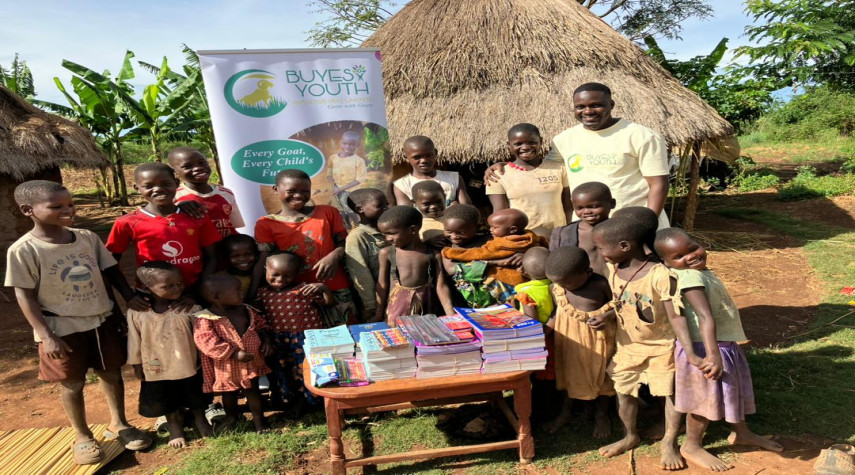
- Reached 450 children and their households in Buyesi Village with goats, clothing, school materials, and training
- Run initial training sessions on goat care, feeding, and reproduction
- Sensitised parents and caregivers so whole households actively support the model
- Secured roughly 2 acres of land for a demonstration farm, plus land for office space (to be refurbished) to anchor training and breed improvement work across the sub-county.
What your money will do
This is a big ask, and I want to be upfront about that. It's a full sub-county rollout aligned to UNSDGS. BYI reports progress quarterly, backed by real data from their tracking system, so as this campaign grows, you'll be able to see exactly which villages and households your support has reached.
The Vision
To be the leading organisation in empowering smallholder goat farmers to achieve economic prosperity, food security and improved livelihoods through sustainable and innovative goat farming practices in Uganda and beyond.
The Mission
To provide training, resources, and support to smallholder goat farmers, enabling them to adopt commercial farming practices, increase productivity and profitable markets, thereby improving their incomes, food security and overall wellbeing while promoting environmental stewardship and social equity.
2,786 households with an asset that grows in value. An entire sub-county where goat-keeping, something most families are already doing informally becomes a properly resourced, trained, and market-connected industry.
A stronger local goat gene pool through better breeding. School fees that are affordable again because there's a real income stream behind them. And, in time, this model spreading further across the wider Eastern Region of Uganda, wherever cotton once thrived and nothing has taken its place.
This isn't aid that ends the day a goat is delivered. It's the foundation of a genuine local economy and I want to help Doughlous and his team build it at the scale their own sub-county actually needs.
Testimonials
In their own words.
These are real families already part of the programme, quoted in BYI's Annual Report for the 2025–2026 financial year:
"This program is so beneficial to my child. He is so passionate about it. We are happy the goat has given birth to two kids, and still maintains a good body score. Our children are inspired and ready to grow their herds. We as parents, we are here to support them." — Lado Silvester, father of Michael
"Ketty loves goats so much. This was a gift to her that we never expected. She normally wakes up, takes the goat to feed, and also helps our neighbours with their goats." — Galandi John, father of Ketty
"My son tells me not to forget his goat in the scorching sun when he is at school. Whenever he comes back from school in the evening, he rushes to give it water and supplements it with other leaves. This is really so amazing, and many children will benefit so much from this program." — Naula Monica, mother of Sisye
"I will support my daughter in this program. It has made us so happy that she has received a goat. I hope to see her grades improve — she has all the requirements needed to study this term. Thank you for loving our family." — Kyakuwa Eseza, mother of Rebecca
"I am happy, I have a goat, I love it. I am a member of Buyesi Youth Initiative." — Naula Rebecca Racheal, programme participant
Frequently Asked Questions
- Are you part of Buyesi Youth Initiative? Yes, by being an independent supporter fundraising in aid of BYI and its Founder, Mr. Doughlous Koche. I don't take any cut of what's raised here; funds go to BYI to run their Programmes.
- Who owns the goat once it's given to a household? The goat becomes the household's asset, cared for with mentor support. Any offspring and future breeding stock stay within the family, building their own herd over time.
- What happens if a goat gets sick or dies? BYI's budget covers veterinary care and vaccinations for each goat's first six months, and their herdsmen and vet technician provide ongoing support after that.
- How do I know the money's being used properly? BYI's e-animal tracking app logs herd health and growth in real time, mentors carry out monthly household visits, and the team publishes quarterly reports summarising impact, challenges, and next steps. I'll share these updates here as they come in.
- Why goats, and not another kind of aid? Goats need very little capital or land, cope well with the region's dry climate, and reproduce quickly, so a single gift keeps growing in value for years rather than being used once.
- What if you don't reach the full target? Every increment still funds real households, BYI's model works at any scale, from one village upward. I'll be transparent about progress and how far each stage of funding takes the project.
- How can I help if I can't donate? Share this page with your network, follow my updates, and help me make new connections, raise awareness to brings the next round of support.
- Every goat placed is a household with a future. Help me bring this to all 28 villages, back this project today.