Why every fundraiser should build relationships before asking for money
One of the biggest mistakes a fundraiser can make is to wait until a campaign is launched before thinking about who might donate.
Successful crowdfunding often begins before the campaign goes live.
A fundraiser should already have a clear idea of the people, groups, organisations and communities who may be willing to support the cause.
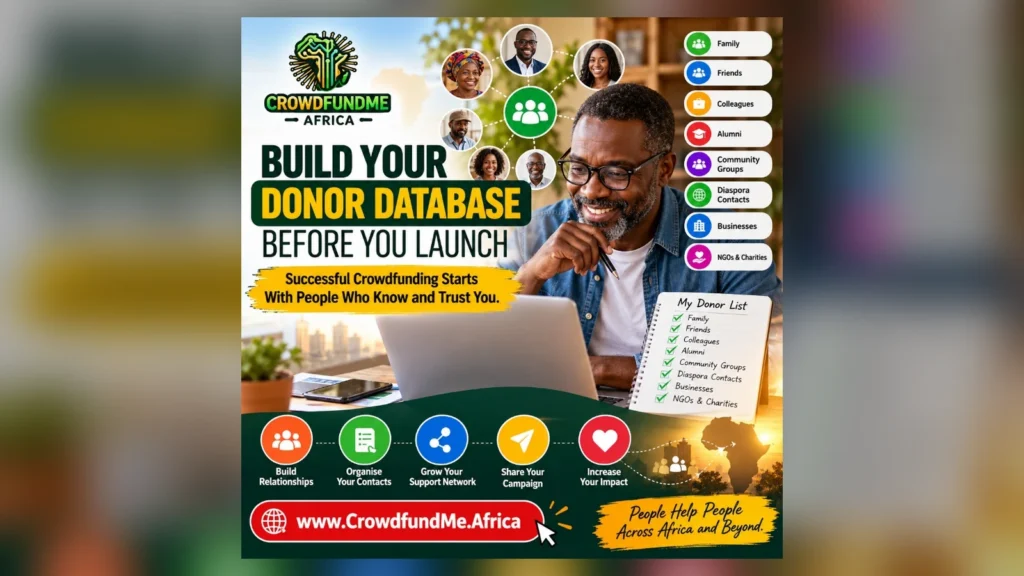
This is why building a donor database is so important.
A donor database does not need to be complicated. It can simply be an organised list of trusted people and contacts who may be willing to donate, share your campaign, introduce you to others, or support you in another way.
For users of CrowdfundMe.Africa, this can make a major difference between a campaign that struggles and one that starts with momentum.
What Is a Donor Database?
A donor database is a structured list of people and organisations connected to you or your cause.
It may include:
- Family members
- Friends
- Colleagues
- Former classmates
- Alumni groups
- Church or mosque contacts
- Community leaders
- Professional contacts
- Business owners
- NGOs
- Charities
- Diaspora associations
- Social-media contacts
- Previous donors
- Supporters who have shared your campaigns before
The purpose is not to collect random names.
The purpose is to identify people you already know, trust, or have a reasonable connection with.
A good donor database helps you understand:
Who should I contact first?
Who may be interested in this cause?
Who can donate?
Who can share?
Who can introduce me to other supporters?
Start With People Who Already Know You
Your first donor database should begin with your existing relationships.
Do not begin with strangers.
Start with people who already know your character, your family, your work, your organisation or your community involvement.
These people are more likely to trust your campaign because they already know you.
Begin by writing down names from the following groups.
Family
Think beyond your immediate household.
Consider:
parents, brothers, sisters, cousins, uncles, aunts, nieces, nephews and extended family.
Some may not be able to donate much, but they may be able to share the campaign.
Friends
Include:
close friends, old friends, neighbours, social friends, sports friends and people you regularly communicate with.
Do not assume somebody will not help before you ask them.
Work and Professional Contacts
Think about:
current colleagues, former colleagues, managers, professional associations, clients, suppliers and business contacts.
A professional contact may not donate personally but could introduce you to someone who can.
School and University Networks
Former classmates and alumni groups can be extremely valuable.
Include people from:
secondary school, university, professional training programmes and former student associations.
Many alumni communities already have a strong culture of helping one another.
Think Beyond Individual Donors
Your donor database should not consist only of individuals.
Organisations can be important supporters too.
Consider adding:
- Churches
- Mosques
- Community associations
- Charities
- NGOs
- Foundations
- Professional associations
- Local businesses
- Social clubs
- Alumni associations
- Cultural organisations
- Diaspora groups
One organisation may be able to introduce your campaign to hundreds of people.
The Diaspora Should Be an Important Part of Your Database
For African fundraising campaigns, diaspora contacts can be particularly important.
Many people living abroad maintain strong emotional connections with their home countries and communities.
Your diaspora database may include:
friends abroad, relatives, former classmates, cultural associations, hometown unions, professional groups and faith communities.
Do not simply send them a link.
Explain the campaign clearly and respectfully.
Tell them why their support matters.
And always encourage sharing.
Divide Your Database Into Different Groups
Do not treat every contact the same way.
A useful donor database should be organised into categories.
For example:
Group A — Closest Supporters
These are the people most likely to support quickly.
They may include:
family, close friends and trusted colleagues.
Contact them first.
Group B — Warm Contacts
These are people who know you but may not be very close.
Examples:
former colleagues, old classmates, professional contacts and neighbours.
Group C — Community Networks
These may include:
churches, mosques, associations, WhatsApp groups, community groups and alumni networks.
Group D — Organisations and Businesses
These may include:
NGOs, charities, companies, foundations and local businesses.
Group E — Previous Supporters
If you have run campaigns or community projects before, keep a record of people who supported you previously.
Previous supporters are often among your strongest future donors.
What Information Should You Keep?
Your donor database does not need to contain excessive personal information.
Keep it simple.
Useful fields may include:
| Information | Purpose |
|---|---|
| Name | Identify the person |
| Relationship | Family, friend, colleague, etc. |
| Phone number | WhatsApp/contact |
| Longer communication | |
| Country | Helpful for diaspora campaigns |
| Organisation | If relevant |
| Contact category | Close, warm, organisation, etc. |
| Date contacted | Helps avoid repeated messaging |
| Response | Donated, shared, interested, no reply |
| Follow-up date | Helps manage communication |
| Notes | Keep brief, useful context |
Do not collect information you do not need.
Good fundraising should also respect privacy.
Never Build a Database by Spamming Random People
A donor database is not the same thing as buying a list of email addresses or phone numbers.
Avoid sending fundraising messages to large numbers of strangers who have never heard of you.
This can damage trust and may also create privacy or data-protection concerns.
Your strongest database is usually built through genuine relationships.
Crowdfunding works best when people understand who you are and why you are contacting them.
Ask People to Join Your Support Network
Another good strategy is to ask trusted supporters whether they are happy to receive future updates.
For example:
“Would you be happy for me to keep you updated about this campaign and future community projects?”
This creates a more respectful relationship.
You are not simply collecting contacts.
You are building a community.
Your Database Should Include Sharers, Not Only Donors
Do not label someone as unimportant simply because they cannot donate.
Some people have valuable networks.
A person may say:
“I cannot donate right now, but I can share your campaign with my church group.”
That person is valuable.
Another may post your campaign to a WhatsApp group containing 200 members.
Another may introduce you to a business owner.
Another may help you create a fundraising video.
Therefore, your database can include different roles:
- Donor
- Sharer
- Connector
- Volunteer
- Organisation
- Influencer
- Previous supporter
Crowdfunding is about more than money.
Build Your Database Before Launch Day
One of the strongest things you can do is prepare your database before publishing your campaign.
Do not launch first and then start thinking.
Prepare a contact list in advance.
For example:
Before launch, identify your first 20 contacts.
These should be your closest potential supporters.
Then identify another 50 people or organisations who can be contacted after the campaign begins.
This means your campaign can receive early activity instead of sitting at zero.
Early momentum matters.
Create a 7-Day Contact Plan
Once your database is ready, create a simple outreach schedule.
For example:
Day 1: Contact closest family and friends.
Day 2: Contact colleagues and trusted professional contacts.
Day 3: Share with alumni and community groups.
Day 4: Approach diaspora contacts.
Day 5: Contact organisations and businesses.
Day 6: Post campaign progress and thank supporters.
Day 7: Follow up politely with people who expressed interest.
This creates structure.
Fundraising becomes easier when it is organised.
Personalise Your Messages
Do not send exactly the same message to everybody.
A close family member should not receive the same message as a business organisation.
For example, to a close friend:
“Hi David, I hope you're well. I have just launched a campaign for [cause]. You know how important this is to me, so I would really appreciate any support you can give.”
For an organisation:
“Dear Sir/Madam, I am reaching out regarding a fundraising campaign supporting [cause]. I would be grateful if your organisation could consider supporting or sharing the campaign with your network.”
Personal messages usually perform better than generic messages.
Do Not Ask Everyone for the Same Amount
Your database should not be used to pressure people.
Avoid saying:
“Everyone must give £50.”
People have different financial situations.
Instead say:
“Any contribution you can comfortably make will be appreciated.”
Some people will give more.
Some will give less.
Some will share.
All can contribute in different ways.
Keep Good Records
A database becomes useful when it is updated.
After contacting someone, note what happened.
For example:
Donated
Shared
Will donate later
Requested more information
No response
Do not contact again
This prevents confusion and helps you communicate professionally.
Follow Up Without Harassing People
Follow-up is important.
Harassment is not.
If someone has not responded, one polite reminder may be appropriate.
For example:
“Hi, just a gentle reminder regarding the fundraising campaign I shared earlier. No pressure at all — if you're unable to donate, sharing the link would also be greatly appreciated.”
Do not message people every day.
Respectful fundraising builds trust.
Thank Donors Immediately
As soon as someone donates, record it and thank them.
Your message can be simple:
“Thank you very much for supporting the campaign. I sincerely appreciate your kindness and contribution.”
Then, if appropriate:
“Please also feel free to share the campaign with anyone who may be interested.”
A good donor database helps you remember who has supported you so nobody is forgotten.
Create a Separate List of Previous Donors
If someone has supported one of your campaigns before, record them separately.
Previous donors are important because they already understand your work.
But never assume they must donate again.
Approach them respectfully.
You might say:
“Thank you again for supporting our previous campaign. We have now launched a new project, and I wanted to share it with you in case you would like to support or share it.”
Previous support should create appreciation, not entitlement.
Build Long-Term Relationships, Not One-Time Transactions
The best donor database is not simply a list of people you contact when you need money.
That approach can damage relationships.
Stay connected even when you are not fundraising.
Share:
- Project updates
- Success stories
- Thank-you messages
- Photos of completed work
- Community achievements
- Reports on how funds were used
When donors can see the results of their contributions, trust grows.
And trust is one of the most valuable assets in crowdfunding.
Protect People's Personal Information
Fundraisers should treat donor data responsibly.
Do not publicly share donor phone numbers or email addresses.
Do not sell or pass contact lists to other people without permission.
Do not add people to large mailing lists without considering whether they agreed to receive messages.
Keep your records secure.
Only collect information that is genuinely useful for your fundraising relationship.
Respect builds long-term support.
Use a Simple Spreadsheet
You do not need expensive software to begin.
A simple spreadsheet can work.
Columns might include:
Name | Relationship | Phone | Email | Country | Group | Contacted? | Donated? | Shared? | Follow-Up | Notes
As your fundraising grows, you may later use a proper donor-management or CRM system.
But start simple.
The most important thing is consistency.
Build a Donor Community Around Your Cause
Your long-term objective should be bigger than creating a database.
You want to create a community of supporters.
People who understand:
who you are, what you are trying to achieve and why your work matters.
A strong supporter community may help you with future projects as well.
This is how charities and organisations develop sustainable fundraising.
They do not start from zero every time.
They build relationships over years.
A Practical Example
Imagine you are raising funds for a community school project.
Your donor database might begin like this:
20 family and close friends
30 former classmates
15 colleagues
10 diaspora relatives and friends
5 church or community groups
10 local businesses
5 NGOs or foundations
That is already 95 potential contacts or networks.
Now imagine each person shares the campaign with five more people.
Your reach can grow rapidly.
This is the power of organised crowdfunding.
Do Not Wait Until You Are Desperate
This may be the most important lesson.
The worst time to start building a donor network is when you urgently need money tomorrow.
Start building relationships now.
Stay connected with people.
Support other people's causes when you can.
Share useful information.
Participate in your community.
Be trustworthy.
When people know you as someone who contributes and communicates responsibly, they may be more willing to support your cause when the time comes.
Your Donor Database Is One of Your Most Valuable Fundraising Assets
The success of a crowdfunding campaign is not determined only by how attractive the campaign page looks.
It is also determined by the community behind it.
A fundraiser who has:
100 trusted contacts, strong relationships, an organised outreach plan and consistent communication
may have a much stronger chance than someone who launches a campaign and waits for strangers.
At CrowdfundMe.Africa, we encourage fundraisers to think beyond simply creating a campaign.
Think about your community.
Think about your network.
Think about who trusts you.
Think about who can introduce you to others.
And begin building those relationships before you need them.
Build your database.
Build trust.
Build relationships.
Then build your campaign.
Because successful crowdfunding begins with people.
CrowdfundMe.Africa
Helping Africa Fund Africa — with support from the world.
Visit: www.CrowdfundMe.Africa