From community contributions to billions raised online
Crowdfunding may feel like a modern invention, but the basic idea behind it is actually very old.
For centuries, people have pooled small amounts of money to help fund books, monuments, community projects, businesses, artistic works and charitable causes. What changed in the 21st century was technology: the internet made it possible for thousands or even millions of people to contribute to a project from anywhere in the world.
Today, crowdfunding is used to support everything from medical treatment and charitable causes to businesses, films, inventions, property projects and community development.
For readers of CrowdfundMe.Africa, understanding where crowdfunding came from is important because it shows that crowdfunding is not simply a Western trend. At its heart, it is based on a principle Africans have understood for generations:
Many people contributing a little can achieve something one person may not be able to achieve alone.
Crowdfunding Did Not Begin With One Person
There is no single person who can accurately be described as the inventor of the entire idea of crowdfunding.
The principle developed gradually.
Long before the internet, writers, artists and community organisers raised money by asking many individuals to contribute in advance.
One famous early example occurred in the 18th century when authors and publishers used subscription funding. Supporters paid in advance so books could be printed.
Another famous example occurred in the United States in 1885.
When funding was needed to complete the pedestal for the Statue of Liberty, newspaper publisher Joseph Pulitzer used his newspaper, The New York World, to appeal to ordinary members of the public for donations.
Thousands of people contributed, many giving relatively small amounts.
The campaign demonstrated a principle that remains central to crowdfunding today:
You do not always need a few wealthy donors. You can mobilise a large number of ordinary people.
The Birth of Modern Internet Crowdfunding
Modern online crowdfunding began to emerge around the turn of the 21st century.
One of the most important names in its history is Brian Camelio.
Camelio founded ArtistShare, which describes itself as the first fan-funded internet platform. ArtistShare was founded around 2000–2001, with its first fan-funded project launching in 2003. It allowed music fans to financially support artists before albums or creative works were completed.
This model was revolutionary.
Instead of an artist first needing a record company, bank or wealthy investor, supporters themselves could help finance the creation of the work.
ArtistShare therefore helped establish many of the ideas associated with modern reward-based crowdfunding.
Then Came the Major Crowdfunding Platforms
Once people saw that online communities could finance projects, more platforms appeared.
Indiegogo
Indiegogo was founded in 2008 by Danae Ringelmann, Slava Rubin and Eric Schell.
It became one of the early large crowdfunding platforms for creative projects, technology products, inventions and entrepreneurial ideas.
Kickstarter
Kickstarter launched in 2009.
It was founded by Perry Chen, Yancey Strickler and Charles Adler.
Kickstarter helped make reward-based crowdfunding known around the world.
People could present a project, establish a funding target and offer rewards to supporters.
Creative industries particularly benefited:
films, music, games, publishing, technology, art and product design.
Kickstarter has since facilitated billions of dollars in pledges to projects. Its earlier milestone data showed billions already pledged by millions of backers, and the platform continues to publish live statistics.
GoFundMe
GoFundMe launched in 2010 and became especially well known for personal and charitable fundraising.
Unlike Kickstarter, which often focuses on creative projects and rewards, GoFundMe became widely associated with:
medical expenses, funerals, emergencies, education, family needs, disasters, charities and personal causes.
GoFundMe currently states that approximately £29 billion has been raised through its technology since 2010, involving more than 190 million people worldwide.
That statistic alone demonstrates how enormous digital crowdfunding has become.
JustGiving and the Growth of Online Charity Fundraising
Another important platform is JustGiving.
It was founded in the United Kingdom by Zarine Kharas and Anne-Marie Huby and launched around 2000–2001 as a digital fundraising platform designed to make giving to charities easier.
JustGiving says that it has now helped raise more than £6 billion for good causes in 196 countries, with millions of people using the platform.
This is particularly relevant for Africa because it demonstrates what can happen when online giving becomes an everyday part of society.
Kiva and Crowdfunded Lending
Crowdfunding is not limited to donations.
Kiva, founded in 2005, created a model where individuals can lend relatively small amounts to entrepreneurs and borrowers around the world.
Instead of donating money permanently, supporters participate in small loans.
By 2025, Kiva reported that its community had funded more than $2.5 billion in loans and reached more than six million people.
Kiva is an important example of debt-based crowdfunding.
How Much Has Crowdfunding Raised Worldwide?
This is one of the most difficult questions to answer precisely.
There is no single worldwide database covering every crowdfunding platform, every country and every crowdfunding model.
Donation crowdfunding, reward crowdfunding, investment crowdfunding, property crowdfunding, peer-to-peer lending and charity fundraising are often measured separately.
Therefore, any claim that one exact figure represents all crowdfunding ever raised globally should be treated cautiously.
However, the figures reported by several major platforms show that the cumulative total is already enormous.
Some publicly reported examples include:
- GoFundMe: about £29 billion raised through its technology since 2010.
- JustGiving: more than £6 billion raised for good causes.
- Kiva: more than $2.5 billion in loans funded.
- Kickstarter: billions of dollars pledged to creative projects over its history.
- In the United States alone, regulated investment crowdfunding under Regulation Crowdfunding had reported around $1.64 billion raised cumulatively by June 2026, according to the U.S. Securities and Exchange Commission.
These figures do not even include every major platform worldwide.
So it is reasonable to say that tens of billions of dollars have flowed through crowdfunding and online fundraising platforms globally, but there is no trustworthy single total covering the entire industry.
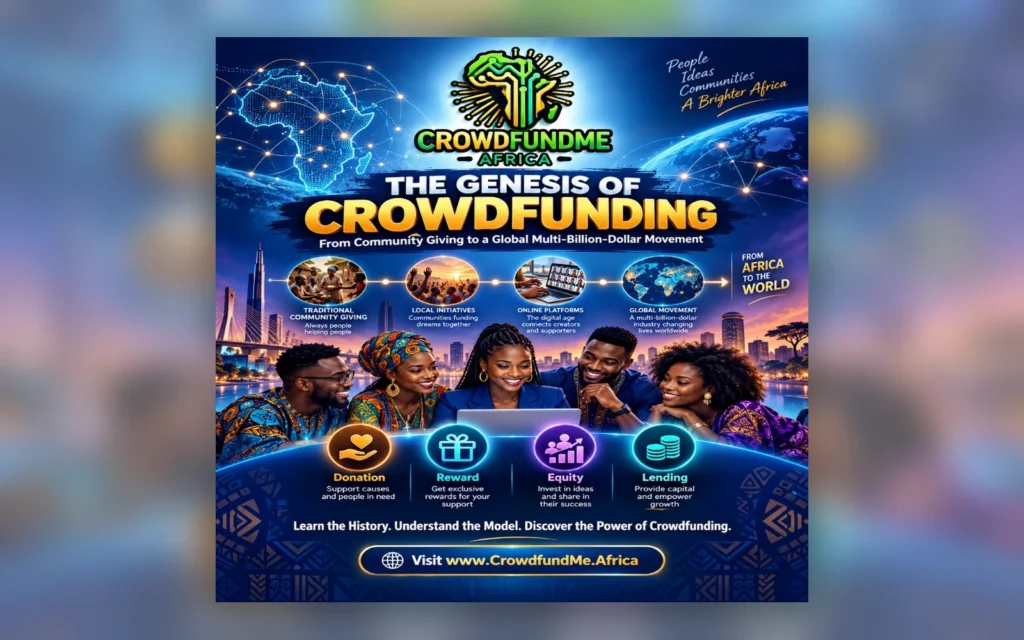
The Four Main Types of Crowdfunding
For readers who are new to crowdfunding, it is important to understand that not all crowdfunding works in the same way.
There are four principal models.
1. Donation-Based Crowdfunding
This is the form most closely associated with platforms such as CrowdfundMe.Africa.
People donate money because they want to support a person, family, charity, NGO, community or cause.
The donor generally does not expect financial repayment.
Examples include fundraising for:
- Medical treatment
- Education
- Emergency support
- Funerals
- Disaster relief
- Community projects
- Charities
- NGOs
- Religious or social causes
- Family hardship
A person may contribute £5, $10, ₦1,000 or another amount simply because they want to help.
Main principle:
You give to support the cause, not to make a financial profit.
2. Reward-Based Crowdfunding
In reward-based crowdfunding, supporters contribute money and receive something in return.
That reward might be:
- Early access to a product
- A book
- An album
- A T-shirt
- A special edition product
- Recognition
- Membership
- An invitation to an event
Kickstarter helped popularise this model.
For example, an entrepreneur developing a new device might say:
“Contribute £50 and you will receive one of the first products when manufacturing begins.”
The supporter is not buying shares in the company.
They are supporting the project in exchange for a reward.
3. Equity Crowdfunding
Equity crowdfunding is very different.
In this model, people invest money into a business in return for an ownership interest or securities.
Instead of being donors, they become investors.
If the company grows significantly, their investment could increase in value.
But they may also lose some or all of their investment.
Because investment crowdfunding involves securities and financial risk, it is regulated much more strictly.
For example, in the United States, Regulation Crowdfunding permits eligible companies to raise investment capital through registered online intermediaries, subject to regulatory rules.
Main principle:
You invest with the possibility of financial return, but also with investment risk.
4. Debt-Based Crowdfunding or Peer-to-Peer Lending
In debt crowdfunding, people lend money rather than donate it.
The borrower is expected to repay the money, sometimes with interest and sometimes under special low-interest or social-impact arrangements.
Kiva is a well-known example of crowdfunded lending.
This model may be used by:
- Entrepreneurs
- Small businesses
- Farmers
- Individuals
- Social enterprises
Main principle:
The money is a loan rather than a donation or investment in shares.
Other Specialised Forms of Crowdfunding
As the industry has developed, other specialised models have emerged.
These include:
Real Estate Crowdfunding — investors collectively finance property projects.
Royalty Crowdfunding — supporters provide capital in return for a proportion of future revenue.
Community Share Offers — local communities invest collectively in community-owned assets.
Islamic Crowdfunding — fundraising structures designed to comply with Islamic finance principles.
Subscription or Membership Crowdfunding — people make recurring monthly contributions to support creators, organisations or projects.
The crowdfunding industry continues to evolve.
What Makes Crowdfunding Different from Traditional Fundraising?
Traditional fundraising often depends on:
large donors, banks, government grants, charitable foundations, wealthy investors or major institutions.
Crowdfunding changes this model.
Instead of asking:
“Who can give us £100,000?”
a fundraiser can ask:
“Can 10,000 people each contribute £10?”
That is a completely different way of thinking about finance.
Crowdfunding distributes responsibility across a community.
Technology Made Crowdfunding Global
The smartphone has been one of the greatest drivers of crowdfunding.
Today somebody can:
create a campaign, upload photographs, tell their story, share the campaign on WhatsApp, receive donations and update supporters without leaving their home.
This makes crowdfunding particularly important for Africa.
Africa has experienced tremendous growth in:
mobile phones, mobile money, digital banking, social media and internet access.
These technologies create the foundation for crowdfunding to grow across the continent.
Why Crowdfunding Has Become So Successful
There are several reasons crowdfunding has grown around the world.
It Gives Ordinary People Access to Fundraising
Previously, somebody seeking money might have needed connections to wealthy people or financial institutions.
Crowdfunding opens fundraising to ordinary people.
It Uses Social Networks
Every fundraiser already has potential networks:
family, friends, colleagues, churches, mosques, alumni groups, professional associations and social-media followers.
Small Contributions Can Accumulate
Crowdfunding proves that £5 multiplied thousands of times can become substantial.
It Allows People to Support Causes They Personally Care About
Donors decide where their money goes.
Campaigns Can Cross Borders
Someone living in London can support a campaign in Lagos.
Someone in New York can support somebody in Nairobi.
Someone in Germany can contribute to a project in Ghana.
This ability to connect the diaspora with Africa is particularly important.
What Africa Can Learn From the History of Crowdfunding
The most important lesson is that crowdfunding succeeds when people believe in collective participation.
Africa already has many traditional versions of this idea.
We contribute towards:
weddings, funerals, medical bills, school fees, religious activities, community development and family emergencies.
Digital crowdfunding does not replace these traditions.
It modernises them.
Instead of 20 people contributing in one village, crowdfunding can potentially connect 20,000 supporters across the world.
Crowdfunding Is Also About Trust
The history of crowdfunding also teaches another lesson.
The system cannot grow without trust.
Potential donors need to believe:
- The campaign is genuine.
- The organiser is identifiable.
- The story is truthful.
- The money will be used appropriately.
- Payment systems are secure.
- Campaign updates will be provided.
For African crowdfunding platforms, building this trust will be essential.
Fundraisers Must Understand Their Responsibility
Crowdfunding creates opportunities, but it also creates obligations.
A fundraiser should:
- Set a realistic target.
- Explain clearly what the money is needed for.
- Use accurate information.
- Avoid misleading photographs or claims.
- Provide campaign updates.
- Thank donors.
- Be transparent about how funds are used.
The more responsible fundraisers are, the stronger the crowdfunding ecosystem becomes.
Crowdfunding Has Become a Global Financial and Social Movement
What began as community subscription and public appeals eventually developed into online platforms capable of raising billions.
From ArtistShare and Kickstarter to JustGiving, GoFundMe and Kiva, crowdfunding has changed the relationship between people who need funding and people willing to provide it.
Today a creator can finance an invention.
A family can seek emergency assistance.
A charity can reach new supporters.
An entrepreneur can seek investors.
A community can fund a project.
A student can seek educational support.
And millions of ordinary people can participate.
The Next Chapter Could Belong to Africa
Africa has many of the ingredients needed for crowdfunding to grow:
A young population.
Strong community traditions.
Large diaspora communities.
Growing smartphone adoption.
Expanding digital payments.
Entrepreneurial talent.
Social-media connectivity.
And countless genuine causes requiring financial support.
The opportunity is not simply to copy crowdfunding models created elsewhere.
The opportunity is to build crowdfunding models suited to African communities.
This is part of the vision behind CrowdfundMe.Africa.
Africans helping Africans.
The diaspora supporting home.
Communities supporting genuine causes.
Small contributions creating larger possibilities.
From One Idea to Billions in Global Support
Crowdfunding was not invented overnight by a single person.
It evolved.
Public subscription campaigns demonstrated the principle centuries ago.
Joseph Pulitzer's Statue of Liberty appeal demonstrated the power of mass public giving.
Brian Camelio and ArtistShare helped pioneer internet fan-funded crowdfunding.
Then platforms including JustGiving, Indiegogo, Kickstarter, GoFundMe and Kiva took different versions of crowdfunding to millions of people.
Today, crowdfunding has become a global movement involving tens of billions of dollars across the major platforms alone.
But the most important number is not the amount raised.
It is the number of lives affected.
Students educated.
Patients treated.
Businesses created.
Communities strengthened.
Creative ideas brought to life.
Families supported.
Charities funded.
And people given hope.
That is the true history — and the continuing promise — of crowdfunding.
CrowdfundMe.Africa
Helping Africa Fund Africa — with support from the world.